Forty Minutes Past the Hour: What the Waiting Room Measures Before Your Doctor Does
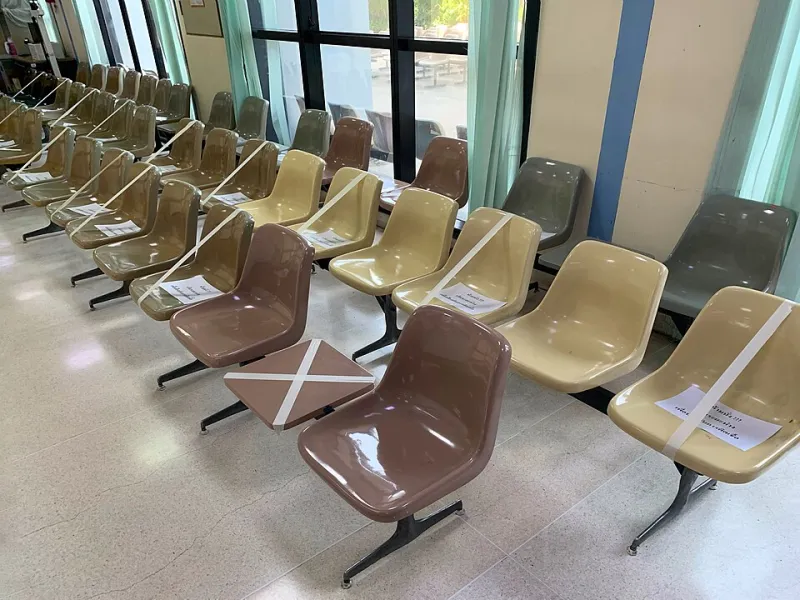
Photo: Chainwit., CC BY-SA 4.0, via Wikimedia Commons
Your appointment was at 10:15. You arrived at 10:02, signed in, sat down, and were called back at 10:51. Nobody recorded any of it. The visit note will say you were seen at 10:15, because that is what was scheduled.
This gap — between the time a patient is promised and the time care actually begins — is one of the most consistently measured and least clinically discussed features of American medicine. Waiting-room time is treated as an administrative residue, a scheduling nuisance. But a growing body of evidence suggests those minutes are not neutral. They alter what patients say, what clinicians hear, and how much trust survives the first handshake. In diagnostic terms, the waiting room is not dead time. It is the first test, and most patients are taking it unprepared.
The Numbers Behind the Chairs
Wait-time research in the United States is fragmented, but the pattern across settings is remarkably consistent. Surveys of physician offices have repeatedly found average in-office waits of 18 to 20 minutes past the scheduled time, with certain specialties — dermatology, orthopedics, and interventional pain among them — regularly exceeding 30 minutes. Emergency departments are a category of their own: national CDC data places median ED wait times at roughly 40 minutes before triage, with total visits frequently stretching past two hours for patients who are ultimately discharged.
Telehealth compressed the wait but did not eliminate it. Virtual visits still run late — typically 5 to 10 minutes, since a physician finishing an in-person appointment cannot instantly pivot to a video call. And the wait has quietly migrated: patients now wait on hold to schedule, wait days or weeks for the slot, wait in a virtual queue for a portal message reply. The waiting room is less a place than a condition.
What almost no metric captures is the cumulative total. Multiply a modest 20-minute delay across a handful of visits per year, per patient, and the aggregate reaches billions of hours nationally — time drawn disproportionately from working people who must arrange childcare, burn PTO, or forgo wages to sit in an upholstered chair.
How Waiting Rewrites the History You Give
The clinical consequences are subtler than annoyance. Studies of patient recall and disclosure suggest that prolonged pre-appointment waiting measurably degrades the encounter itself.
First, there is the anxiety effect. Anticipatory stress rises with wait duration, and anxious patients structure their narratives differently — leading with the most frightening symptom, omitting context that suddenly seems irrelevant, or minimizing complaints to avoid seeming difficult. A clinician relying on the classic opening question, 'What brings you in today?', receives a compressed, anxiety-filtered answer. The differential diagnosis is built on that answer.
Second, there is the resentment effect. Research on patient satisfaction consistently links perceived wait time to trust in the physician — even when the physician personally had nothing to do with the schedule. Trust, in turn, predicts disclosure. Patients who feel devalued before the exam begins are less likely to mention the symptom they find embarrassing, the medication they stopped taking, or the second glass of wine they didn't mention last time.
Third, there is fatigue. A patient who has waited 50 minutes, often after taking half a day off work, may genuinely struggle to engage with a complex treatment discussion at the end of it. Health literacy researchers have long noted that comprehension drops when cognitive load is high. The wait taxes exactly the resource the visit depends on.
None of this appears in the chart. The note will document the chief complaint, the review of systems, the plan. It will not document that the patient was asked to perform a diagnostic interview while stressed, tired, and quietly furious.
Using the Wait Strategically
Patients cannot fix the scheduling system, but they can treat the wait as part of the clinical encounter rather than a prelude to it.
- Arrive with a written agenda. Waiting-room time is ideal for reviewing — not composing — a short written list of symptoms, questions, and medication changes. Composing it in the chair, under rising stress, is how items get forgotten.
- Rank your concerns before you're called. If you will get only eight minutes of face time, decide in advance which symptom matters most. Lead with it. Clinicians triage within the visit just as nurses triage at the door.
- Ask for the delay's cause without apology. A neutral question — 'Is the doctor running behind today?' — signals that you track time and often prompts the front desk to offer rescheduling when the delay is severe.
- Know when to reschedule instead of waiting. If you are called in visibly agitated, or the delay exceeds an hour, it is legitimate to ask whether a follow-up slot later in the week would serve the purpose better than a rushed visit today. A compromised history can lead to a compromised workup.
- Use the portal. Uploading your symptom timeline and questions before the visit gives the clinician a chance to review them — and gives you a record that you raised them, regardless of how rushed the appointment becomes.
The Case for Counting the Wait
Here is the uncomfortable argument: if waiting measurably affects diagnostic quality, it should be counted as diagnostic time — and compensated accordingly.
American medicine bills by the encounter, and the encounter officially begins when the clinician enters the room. But the inputs to that encounter — the patient's stress level, fatigue, recall, and willingness to disclose — are being shaped for the preceding hour, unpaid and unrecorded. Insurance pays for the visit. Nobody pays for the visit's degraded conditions, and no quality metric penalizes the practice that produces them.
A modest proposal: waiting-room time beyond a reasonable buffer (say, 15 minutes) should be a reportable metric on payer scorecards and public quality ratings, the way infection rates and readmission rates are. Practices running an hour late would carry the same visible blemish as practices with poor outcomes, because — in a meaningful sense — the outcomes are connected. Alternatively, delayed patients could receive a documented good-faith gesture, as airlines do, not as a courtesy but as an acknowledgment that the patient's time is an input to care.
Critics will say this misreads the problem: physicians are not late by choice but by the arithmetic of American primary care, where panel sizes and reimbursement rates make overbooking a survival strategy. That is true, and it is precisely the point. The waiting room is where the system's structural shortcuts become visible. Counting them would make the invisible cost of those shortcuts legible — to payers, to practices, and to the patients currently absorbing them in silence.
The chair by the window is not part of your exam. But everything that happens in it shapes the exam. It deserves a line in the record.